Fuel Prices: Why They Go Up Fast… But Come Down Slowly
Lufop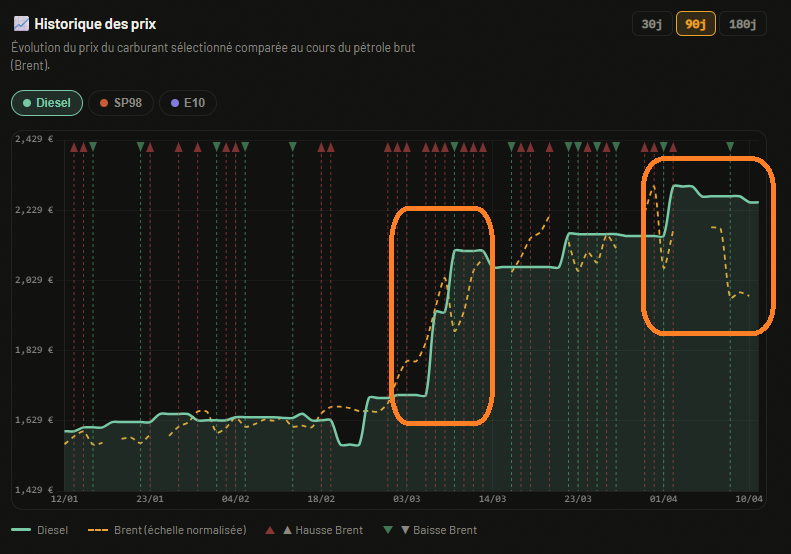
For several weeks now, one question has been coming up repeatedly among drivers: why do fuel prices rise quickly… but never fall as fast?
In a context of tension on the oil market, this is not just a feeling — it is based on a well-documented economic phenomenon known as the “rockets and feathers” effect.
And today, the data observed in France clearly confirms this asymmetry.
📊 High prices despite falling oil
As of April 11, 2026, national averages remain high:
- Diesel: €2.332/L
- SP95 (Petrol): €2.056/L
- SP98 (Petrol): €2.097/L
- E10: €2.001/L
Source: data.gouv.fr – prix-carburants.gouv.fr (Open Licence Etalab 2.0)
At the same time, crude oil prices (Brent) have experienced periods of decline. Logically, pump prices should follow… but this only happens partially.
📍 Real example: a station in Gironde
Let’s take a real case observed on
Intermarché Saint-Symphorien (33113)
- Diesel: €2.252/L (i.e. -3.4% below the national average)
- SP98: €2.062/L
- E10: €1.939/L
👉 This station is actually among the cheapest in its area, with a local price index of 20/100.
Despite this, prices remain high in absolute terms. And more importantly, they do not immediately reflect the drop in crude oil prices.
👉 View the station:
https://pompe.lufop.net/station/33/saint-symphorien/33113002
🚀🪶 The “rockets and feathers” effect: a well-known mechanism
This phenomenon was identified as early as the 1990s by economist Robert Bacon:
- 🚀 When oil prices rise → fuel prices increase quickly
- 🪶 When oil prices fall → fuel prices decrease slowly
Source: Bacon, R. (1991), “Rockets and Feathers” – Energy Economics
⚙️ Why does this asymmetry exist?
Several factors explain this gap:
1. ⏱️ Time lag effect
Fuel sold today was purchased, refined, and transported days or even weeks earlier. Distributors are therefore selling stock bought at higher prices.
2. 🛢️ Refining and logistics
The final price does not depend solely on crude oil, but also on:
- refining
- transport
- distribution costs
Source: International Energy Agency (IEA), Oil Market Reports
3. 💰 Heavy taxation
In France, more than 50% of the fuel price is made up of taxes (TICPE + VAT).
👉 This mechanically limits the impact of falling oil prices on the final price.
Source: INSEE – Fuel price composition
4. 📈 Pricing strategies
Retailers often adjust prices faster upward than downward, depending on:
- local competition
- margins
- demand
📉 A very real frustration for drivers
This mechanism creates a perceived imbalance:
- Price increases are immediate and visible
- Price decreases are gradual and discreet
As a result, even when oil prices fall, people feel that fuel prices remain stuck at high levels.
📊 What current data shows
Analysis of price curves over 30 to 90 days highlights:
- A strong correlation between Brent and fuel prices
- A time lag (several days delay)
- An asymmetrical response (faster increases than decreases)
👉 Exactly what we are observing today.
🧠 Conclusion: a normal (?) phenomenon… but hard to accept
The asymmetry in fuel prices is neither a bug nor a recent anomaly: it is a well-documented economic reality for over 30 years.
But in times of energy crisis, it becomes particularly visible… and frustrating.
👉 As long as the market remains subject to these constraints (stocks, taxation, logistics), it is likely that:
- price increases will remain rapid
- price decreases will remain slow
A phenomenon that turns every trip to the pump into a daily economic barometer.
🔎 Track prices in real time
To monitor fuel prices around you and find the most competitive stations:
Official data: prix-carburants.gouv.fr – updated daily
Si cet article vous a intéressé n'hésitez pas à  vous abonner aux flux par RSS,
directement  par eMail ou suivez-moi sur twitter @Lufop
Le site vous est utile? Soutenez le site lufop.net :

Si tu as une question ou un problème, utilise le forum, il est là pour ça.


 France
 Belgique
 Italie
 Allemagne
 Suisse
 Espagne
 Suede
Suede Portugal
 Pays-Bas
 Luxembourg
 Grande-Bretagne
 Pologne
 Andorre
 Irlande
 Lettonie
 Republique Tcheque
 Bulgarie
 Canada
 Australie
 Nouvelle-Zelande
 Norvege
 Emirats Arabes Unis
 Maroc
Maroc Finlande
 Bresil